
Waushara Deeds and Transfers
The Register of Deeds serves as Waushara County's recording custodian. It handles deeds and every related land instrument. Recording a deed places the document in the public record. It does not settle every title question by itself. The county fee schedule shows the range of document families the office accepts. These include deeds, mortgages, land contracts, terminations of decedent's interest, transfer-on-death designations, certified survey maps, lis pendens, federal tax liens, UCC filings, and miscellaneous instruments.
| Deed Type | What It Does | Common Use |
|---|---|---|
| Deed | Records a conveyance between named parties | Trace a transfer and its legal description |
| Land contract | Records a contract interest tied to land | Check a recorded financing arrangement |
| Transfer-on-death designation | Names a beneficiary path recorded against the parcel | Review a non-probate transfer document |
| Termination of decedent's interest | Records termination of an interest after death | Follow an estate-related land record |
| Mortgage, lien, or lis pendens | Records an encumbrance or pending claim | Check documents affecting a parcel |
Not every recorded document is a deed. A deed transfers an interest. A mortgage or lien records a claim against the land rather than a new owner. A lis pendens gives notice of a pending case that may affect the property. The difference matters when one party name pulls up a long list of results. Read the instrument type, the party roles, the legal description, and the recording reference. Only then call an entry a sale.
Waushara Deed Index Starts in 1978
Waushara County reports full indexing and imaging from January 1, 1978 forward. The imaged collections include Records Volume A and Mortgages Volume A onward. Treat that date as the dependable marker of online depth. Anything earlier calls for a different route. A book, microfilm, or staff-assisted search at the Register of Deeds usually wins there. It beats another round of name spellings in the portal.
The Register of Deeds page also links several record series. These include certified survey maps, subdivision and plat maps, tract indexes, miscellaneous books, lis pendens books, corporate books, grantor/grantee books, and numbers books. Each series can hold a different filing type. A simple deed-name search can still return nothing. A document can exist anyway. Note the book family and reference number before asking for help. The county's online records page confirms the coverage statement and the image paths.
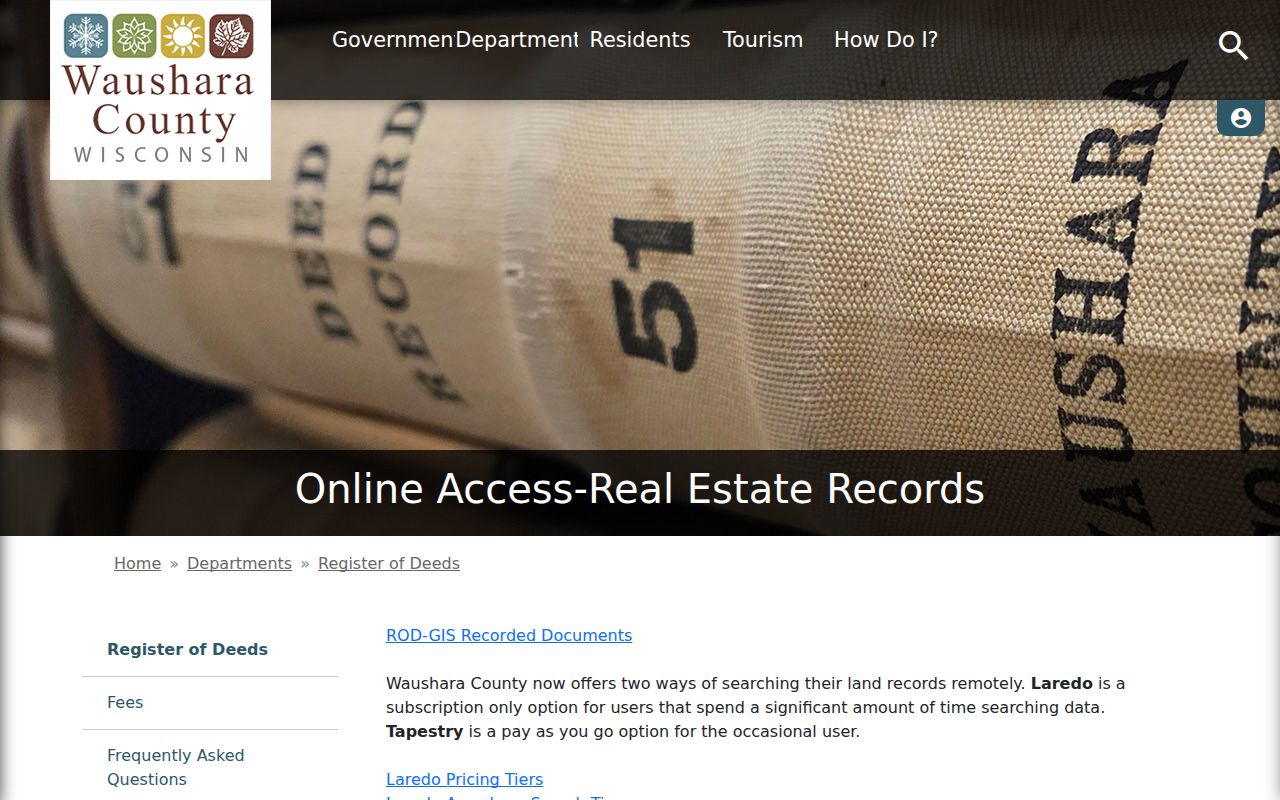
Note: The county's entry page displays the official coverage statement and the links into each records collection.
Choose a Waushara Deed Search Route
Waushara County names two remote products: Laredo Anywhere and Tapestry EON. Laredo is the subscription route for frequent users. Tapestry works on a pay-as-you-go basis for occasional searching. That split concerns access style only. Neither product replaces the Register of Deeds as custodian. Neither substitutes for a certified copy when a formal copy is required.
Search fields, required flags, sort order, pagination, export behavior, and per-image pricing live inside the products themselves. Confirm those details in the live tool before building a workflow around them. The county page remains the dependable first stop for current links. A researcher who needs just one instrument can also ask the office about counter or mail options and the current copy charge. Use the county link to compare its Laredo and Tapestry EON access choices.
Waushara Miscellaneous Book Clues
Waushara's index is not one flat list. The county maintains grantor/grantee books and numbers books. It also keeps tract-index, corporate, lis pendens, and miscellaneous books alongside them. Miscellaneous-book images may be indexed only by volume, page, and document number. That quirk has a practical effect. A name query can miss a filing. The office can retrieve it instantly once the book reference is known.
Write down every reference visible in a related deed, tax bill, court file, or plat. Then ask the Register of Deeds which series holds the record you need. The legal description might use a subdivision lot, a section-township-range description, or a metes-and-bounds call. Compare that text across instruments before deciding two same-name entries concern the same land.
Trace Waushara Grantors and Grantees
A grantor gives an interest and a grantee receives it. To trace a Waushara chain backward, start with the most recent deed or index entry. The grantee on that instrument is the apparent new holder. Find that same name as a grantor in the next earlier transfer. Repeat until you reach the desired period or the online coverage boundary. A chain holds up best when every link matches the same legal description. A similar street address alone is not enough.
- Find the latest conveyance and note the grantee, grantor, date, instrument type, and legal description.
- Search the grantee's name as a grantor to locate the preceding conveyance.
- Compare each description and parcel reference; do not rely on a name match alone.
- Stop at the online depth boundary and ask the office about older books or archives.
- Grantor
- The party shown as transferring an interest in an instrument.
- Grantee
- The party shown as receiving an interest in an instrument.
- Chain of title
- The sequence of recorded transfers tied to one parcel description.
- Book/page and document number
- References that help retrieve a filed instrument or image.
Waushara Copy Fees and Mail Returns
Copying sits apart from recording. Waushara County charges $2 for the first page of a recorded copy, then $1 per page after it. Certification adds a dollar. An unrecorded document costs $1 per page. Recording most common instruments runs $30 regardless of page count, while subdivision, condominium, and cemetery plats cost $50 each and transportation project plats cost $30. Covered conveyances also owe a real-estate transfer fee, with exemptions claimed through the required fee or exemption number.
Everything must be prepaid. The schedule prices card processing by payment amount, so confirm the current charge before paying by card. Starting January 1, 2025, a paper recording needs a self-addressed stamped return envelope, and an electronic-return agreement can supply a free electronic return instead. Mailed requests should carry enough identifying detail to locate the record and a return path the office accepts. That detail speeds the copy.
For the full breakdown, the county's Waushara recorded-document fee schedule lists every copy and recording charge. Check it before mailing payment. Changes get posted there.
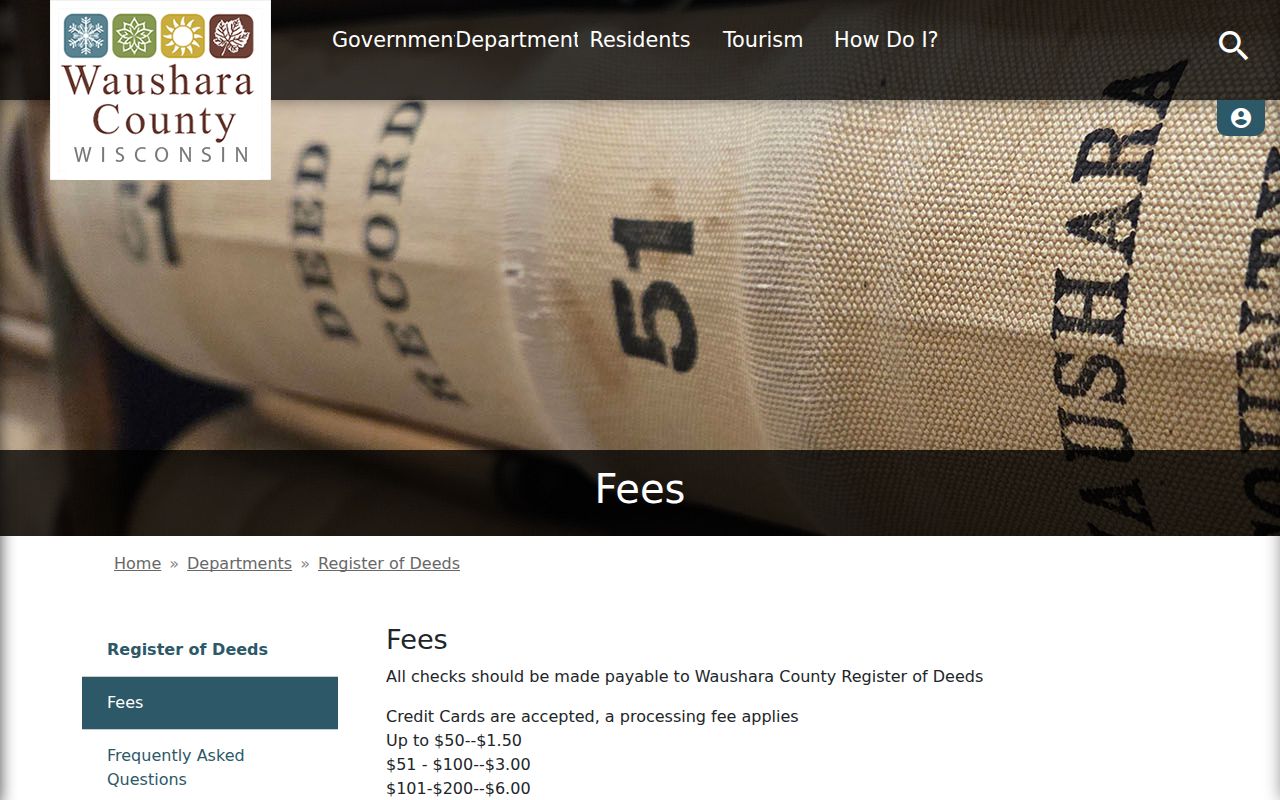
Check the live schedule before mailing a document or ordering a certified instrument copy.
Waushara Recording Notifications
The Register of Deeds runs a recording-notification service, also called a property-fraud alert. Signing up gets you a notice when a covered document is recorded. The notice covers a chosen name or property reference. Waushara County pairs the two names on one service. Check the exact alert terms on the live signup page. It is a notice service only. An alert cannot block a valid filing. It is no substitute for a title search.
Keep your parcel number handy. When a notice arrives, check it against the actual recorded document. An unfamiliar alert deserves a call to the Register of Deeds. Ask to review the instrument image or request a certified copy. Record the document number and recording date for reference. Those references help the office tell an alert on the right parcel apart from a similar name. They also distinguish it from a nearby property.
The county's official recording notification page is where signup begins.
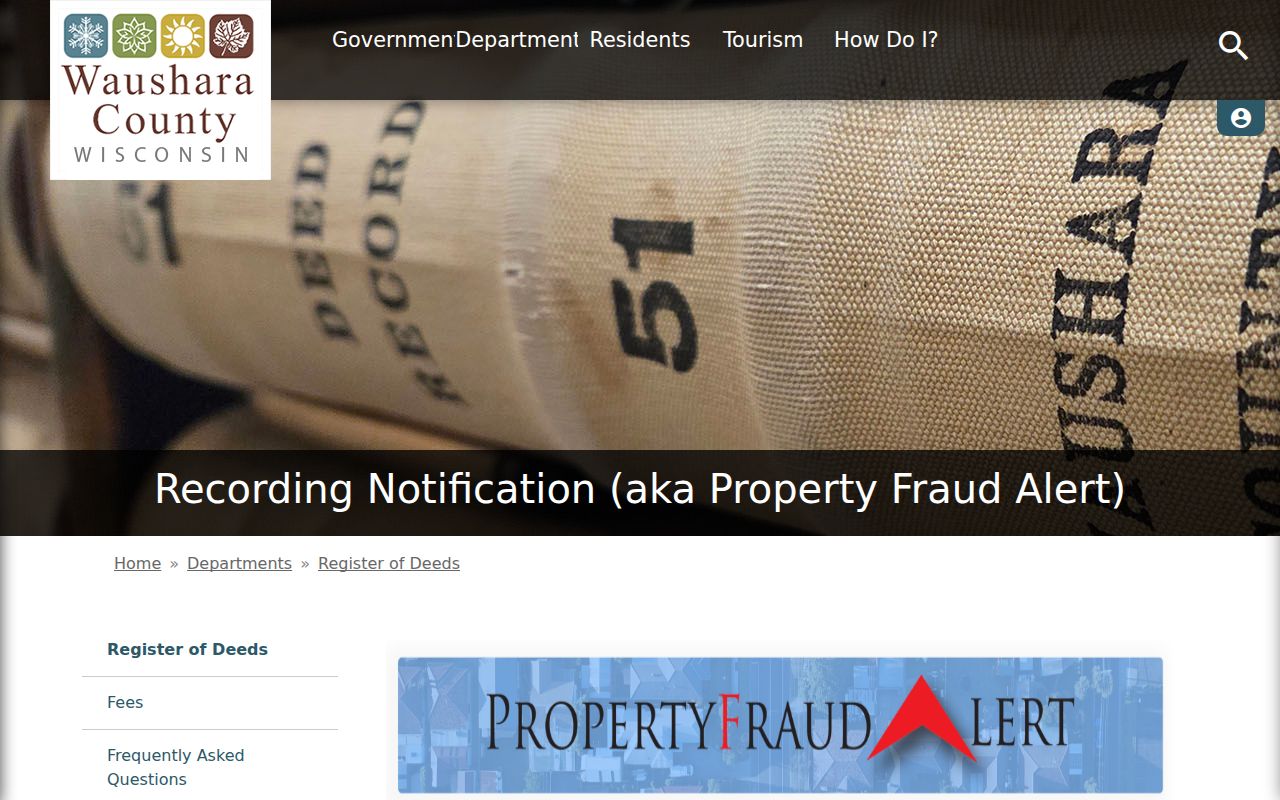
The screenshot captures the county's page but not the later vendor form.
Waushara Surveys and Older Deed Books
Not every map in a Waushara deed search belongs to the Register of Deeds. Recorded CSMs and subdivision plats come through deed-record links. Plats of survey stay elsewhere. The County Surveyor holds those. The county FAQ names Jerry Smart as the surveyor contact. Recent plat books can be purchased through UW Extension. That split matters when a deed cites a survey missing from the recorded-index image list.
Older chains run deeper. Ask about the earlier grantor/grantee books, the tract index, deed books, and archive copies. Wisconsin Historical Society collections hold Waushara historical maps. Name-index material sits there too. A courthouse history source notes a public site file for the former Wautoma building. Archives add context. But they cannot replace the recorded instrument that ties a legal description to a conveyance.
The county's Register of Deeds FAQ separates recorded plat material from surveyor-held plats.
Order Waushara Recorded Deeds
Remote access comes two ways. Laredo Anywhere serves frequent users through a subscription. Tapestry EON suits occasional lookups with pay-as-you-go billing. The Register of Deeds FAQ notes that copies may also be purchased at the office or through online land-record links. For a certified copy or an unimaged instrument, contact the office with the parties, document type, date range, book/page or number, and parcel description when known.
Recorded copies cost $2 for the first page. Later pages are $1 each, and certification adds $1. Unrecorded documents run $1 per page. Recording a common instrument is $30 regardless of page count, and plat types carry separate charges. Fees are prepaid, and since January 1, 2025, paper recordings need a self-addressed stamped return envelope, though an electronic-return agreement can provide a free electronic return. These charges are separate from the vendor's access price.
Recorded, not guaranteed. The Waushara deed index shows instruments on file, not every private claim or title exception. A complete title review requires the relevant records and professional judgment.