
Read Waushara Property Tax Records
A Waushara tax bill lays out the fields that build the annual charge. It names the parcel and the owner of record. It lists the assessed value, the assessment ratio, and fair-market value. Every taxing jurisdiction involved appears there too. The bill then shows gross tax, special assessments, net tax, credits, and payment options. The amount due closes it out. The Treasurer's bill is the clearest single record for taxes. Assessment questions still belong with the municipality's assessor. County land records coordinate assessment work without replacing local valuation decisions.
| Field | What It Shows | Where |
|---|---|---|
| Parcel and owner | Identifies the taxed property and listed owner | Ascent and tax bill |
| Assessed value and ratio | Assessment figures carried for the tax year | Municipal assessor and bill |
| Fair-market value | Value field shown on the tax bill | Treasurer bill |
| Gross, net, and special charges | Tax calculation and added district or parcel charges | Treasurer bill |
| Credits and payments | Lottery credit, school-tax credit, and payment status | Ascent and Treasurer |
Assessed value feeds the local tax calculation. Fair-market value sits on the bill as a separate field. Neither figure guarantees a sale price or a current appraisal. The bill also carries the mill rate, tax-base comparisons, state aids, the legal description, and installment options. To read the value fields correctly, compare them with recorded sale documents and assessor material. Dividing the tax due by a rate produces a number, not a market estimate.
Find a Waushara Tax Bill
The county Treasurer's page links bill and payment information, tax-deed notices, and Ascent. Start with the parcel number when you have it. Without one, locate the property in Ascent. Carry its parcel key into the bill search. Check current and prior bill years separately. A payment entry records the tax account, while a deed records a transfer. Keep those two questions distinct when tracing a recent sale or a delinquency.
- Open the county Treasurer page and follow its current tax-bill or payment link.
- Search with the parcel key from Ascent or the address shown on the property record.
- Read the owner, assessed value, ratio, district fields, credits, charges, and payment status.
- For a value dispute, contact the municipal assessor; for an unpaid balance, use the Treasurer's delinquency information.
- Assessed value
- The value set by the municipal assessor and used in the property-tax process.
- Assessment ratio
- A bill field that places the assessed amount beside its fair-market value measure.
- Lottery and gaming credit
- A credit shown in the county tax record when it applies.
- Special charge
- A parcel or district charge listed apart from the basic tax calculation.
Waushara Ascent Holds Tax Details
The county Treasurer presents Ascent as the current public hub for recorded documents. It also covers ownership, mailing addresses, assessments, property addresses, tax payments, and lottery credits. That consolidation lets a researcher start from one parcel card. Even so, each value carries its own source and year. Before comparing a figure with a listing or a deed's consideration, check what it measures. The figure may be assessed value, fair-market value, a gross tax, a net tax, or an amount already paid. Ascent's public screen shows parcel, owner, and site-address labels. Its dynamic fields change per parcel. So the display should not be read as a complete field specification. The Treasurer portal remains the place to confirm payment timing and bill detail. Save the parcel number and bill year. Then use the bill's jurisdiction and charge lines to bring an assessment question to the right municipality. The county Treasurer page links to the current Ascent and tax services.
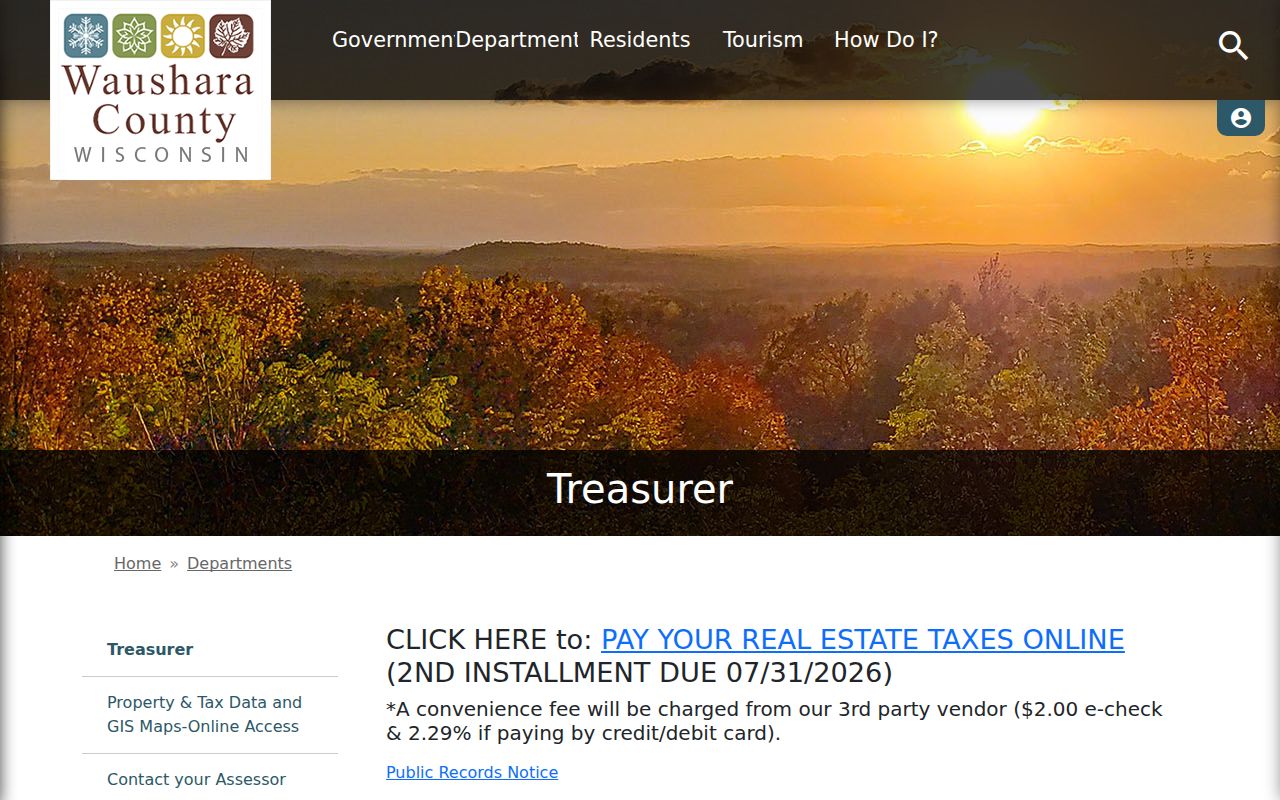
The county Treasurer's online page is the entry point for Waushara tax bills and tax-deed notices; its current links lead to parcel-specific amounts.
Waushara's July 31 Installment Rule
The county Treasurer warns that missing the second-installment deadline of July 31 triggers interest and penalty. The rate is 1.5 percent per month. It applies retroactive to February 1. That detail makes the installment line worth checking on its own. Read only the total and you can miss it. Confirm the current tax year and payment status in the official record before sending funds. A late charge can land even when a payment plan or mailed check is part of the owner's plan. Have the bill's parcel and bill numbers ready when contacting the Treasurer. The listed mailing address may be stale. The county Treasurer page also offers a mailing-address change route. Keep proof of every payment. Compare it with the portal entry if the account still shows a balance. A county tax record does not automatically update a municipal assessment. The assessment and collection roles are distinct.
Waushara Lottery and Gaming Credit
The county Treasurer lists lottery-and-gaming-credit information among its tax services. Ascent carries credit details in the current portal. Read the credit line on the bill. Compare it with the parcel and owner shown. Not every property receives the credit. The credit affects the tax result, while the assessment fields describe the municipal valuation record. If the credit seems missing or the owner information is stale, ask the Treasurer which form applies for that tax year. Ask which correction path applies as well. Keep the tax bill and any correspondence together. That builds a clear record of what was billed. It also shows what was paid and what credit was applied. The public tax record helps explain the account. The county's instructions control the claim process, so follow those.
Waushara's 2026 Tax-Deed Cycle
Waushara County plans to start tax-deed foreclosure in 2026, and the eligible parcels reach Tax Years 2022 and prior. The timeline follows a fixed rule. The Treasurer issues a tax certificate every September 1, and a parcel becomes eligible for county action two years after that certificate. Sales of tax-deed properties run by sealed bid.
A delinquency entry alone proves little. A tax certificate is not a finished tax deed. Foreclosure must run through the court record first. Only the recorded instrument completes the conveyance. Ownership questions and unpaid tax status sit in different records. The owner of record, the certificate, the foreclosure case, and the final deed each tell their own story. Keep them separate before taking any legal step.
The 2026 timing says nothing about a specific parcel. It does not confirm that any foreclosure has finished either. Recheck the county's current notice before acting. It lists eligible parcels, deadlines, bid terms, and any payment needed to redeem. An older dated notice is never a substitute for the live official account. For parcel-level status, use the county's own packet. Current details appear on the Waushara County tax-deed information page.
Waushara Assessment Is Not Sale Value
A Waushara tax roll exists for tax administration. It does not predict a sale price. Each bill lists assessed value, the assessment ratio, fair-market value, taxing jurisdictions, tax-base comparisons, state aids, the mill rate, gross tax, net tax, and special charges. A higher tax does not always mean a higher assessment. Credits, charges, and levies can shift the total. Read the whole bill before drawing a value conclusion.
Municipal assessors set the assessed value. The county land-records office coordinates parcel descriptions and assessment data instead. A recorded sale proves a transaction, not an automatic update to every tax figure. Compare the three values side by side, using the assessor's record and the deed record together. The separate Waushara home value page explains what each value means without repeating bill and appeal steps.
Challenge a Waushara Assessment
Assessment questions belong with the municipal assessor. The Register of Deeds does not handle them. County land-records staff instead coordinate ownership and parcel descriptions with municipal assessment work. If the assessed value looks wrong, ask the assessor which review calendar and Board of Review procedure apply in that municipality. Waushara County publishes no single countywide appeal date. Do not assume one shared meeting schedule.
Start with the parcel number. Add the bill year and the assessed-value and ratio fields. Evidence should speak to the property being assessed. A recent recorded sale, parcel description, or comparable assessment record can help the conversation. One sale is still not an appraisal, so ask what evidence the municipality accepts and when it must arrive. Keep the written notice, submission date, and any decision with that year's tax bill.
Confirm the local date. Appeal timing is set through the municipality's Board of Review process. Contact the assessor for the parcel's municipality before filing; a countywide deadline was not verified in the research.